How long does an air source heat pump installation take?
Fitting an air source heat pump in a typical UK home usually takes between two and five working days on site, based on published guides from UK installers and energy suppliers. The whole journey, from the first survey to a working system, takes longer, often several weeks, because the survey, design, any planning checks and booking a date all come first. A survey of your home is what confirms the plan and the timings for your house.
The stages, step by step
Every installation follows roughly the same order. The times below are typical ranges taken from published UK guides, not promises. Your own home will set the pace.
- A few hours
Home survey
An engineer checks your rooms, windows, insulation, radiators and pipework, and where the outdoor unit and hot water cylinder could go. British Gas says about a couple of hours; Hometree says from a couple of hours to over a day.
- No set time
Heat loss calculation and design
The installer works out how much heat each room loses on a cold day, then sizes the heat pump, cylinder and any radiators to match. You receive a design and a quote to approve.
- Usually quick
Planning check
Most homes in England can fit an air source heat pump without applying for planning permission. If an application is needed, GOV.UK says most are decided within 8 weeks.
- Varies
Waiting for a date
This depends on the installer's diary. As one example, Octopus Energy says its installations are usually 4 to 16 weeks away once approvals are complete.
- 2 to 5 days
Installation
From a couple of days (Vaillant) to around five days (British Gas). Heat Geek puts it at about 3 to 5 working days, depending on the size of the home and whether pipework or radiators need changing.
- Final day
Commissioning and handover
The system is filled, tested and set up, then you are shown how to use the controls.
- Afterwards
Paperwork
Your installer tells your local electricity network operator about the new heat pump and issues your MCS certificate, the record that the system was fitted to the national standard.
What a typical installation week looks like
EDF publishes a useful day by day outline for its own installations, which take four or five days in total.
Getting ready
Preparing the site, checking the equipment and draining the old system.
Pipework and electrics
Pipework and electrical connections, which may mean a short power cut.
Radiators and switch over
Any planned radiator upgrades and the switch over from the old boiler.
Fill, test, set up
Filling, testing and setting up the controls.
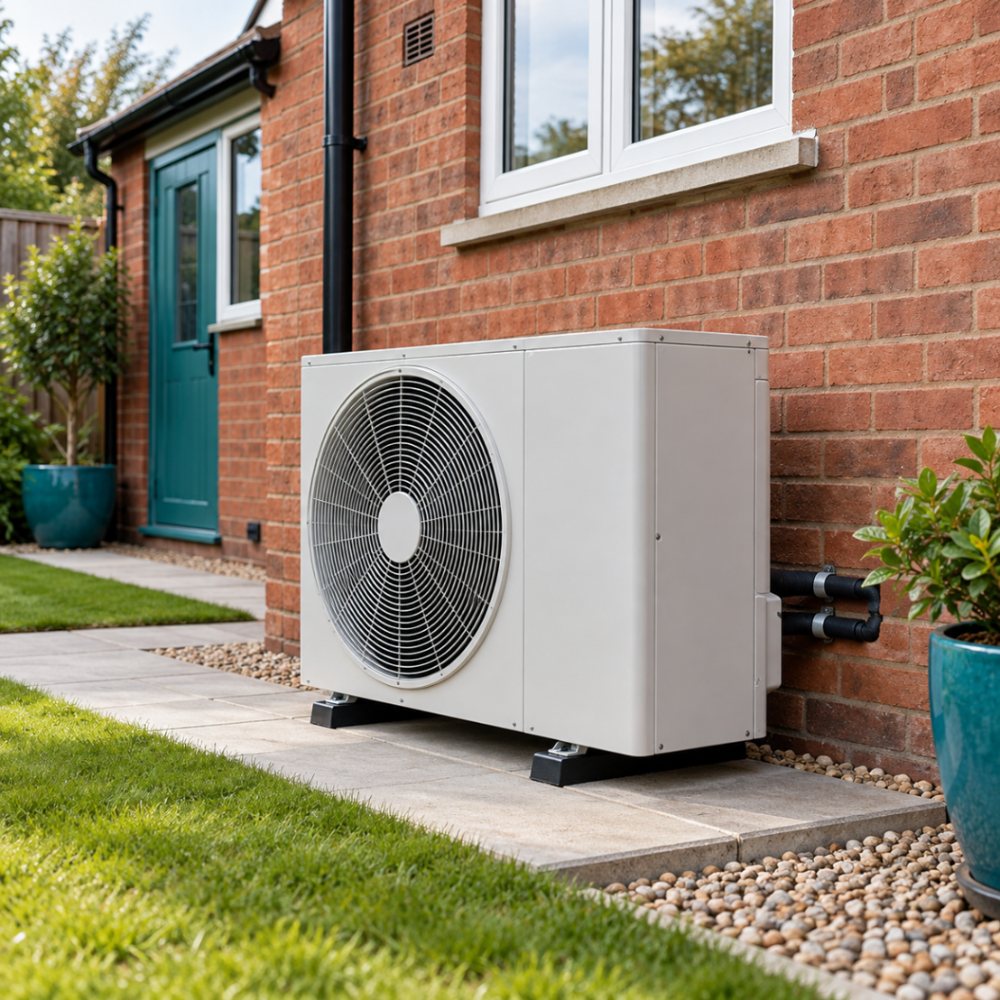
The outdoor unit is often the quickest part. Hometree notes it can be mounted and connected in just a few hours once the work inside the home is done.
Radiators and the hot water cylinder
Do you need planning permission?
For most homes in England, no. Rules that came into force on 29 May 2025 made it easier to fit an air source heat pump as permitted development, which means no planning application is needed as long as certain limits are met:
- The old rule that the unit must sit at least 1 metre from your boundary has gone.
- A detached house can have up to two heat pumps. Other houses can have one.
- The outdoor unit must be no bigger than 1.5 cubic metres.
- The installation must pass the MCS 020 a) sound calculation, which checks the noise the unit will make at nearby homes.
If you live in a listed building or a conservation area, the Planning Portal advises checking with your council first.
What can make it take longer
Most delays come from the house itself or from paperwork, not from fitting the heat pump.
- Radiators or pipework
- Several radiators or lengths of pipework needing to be replaced
- Hot water cylinder
- A new cylinder, especially if it has to go in a new place
- The old boiler
- Removing it, which Aira says can add time
- Fuse board
- An older fuse board that needs upgrading first
- Bigger electrical load
- Between 60 and 100 amps, MCS says the installer must apply to the network operator first, who assesses it within 10 working days
- Planning application
- For example a listed building, usually decided within 8 weeks
- Scaffolding
- For awkward access. Octopus Energy puts it up the week before
Will you have heating and hot water during the work?
Expect a short time without them, usually no more than a day.
British Gas says hot water can be off for up to a day, and an immersion heater (an electric element inside the cylinder) may avoid any gap. Octopus Energy says hot water is usually back on by the end of the first day. EDF fits the heat pump before removing the old boiler to keep the time without heating as short as possible.
How AuraNord does it
AuraNord, part of Nord Group, works in six stages: an online consultation, a home survey, design and quote, installation, commissioning and handover, then ongoing support. At the survey, an engineer carries out a room by room heat loss calculation and checks your pipework, radiators and cylinder sizing, so the quote shows any radiator upgrades before work starts.
Depending on the size of the system and any radiator or cylinder upgrades.
At handover, every setting is checked and you are shown how to use your controls. AuraNord is MCS certified and covers Nottinghamshire, Derbyshire, Leicestershire, Lincolnshire and Yorkshire.
Book your free home survey with AuraNord and get a clear plan, and a timeline, for your own home.
Get a surveyQuestions people ask
Can an air source heat pump be installed in one day?
The outdoor unit can sometimes be mounted and connected in a few hours, but a full installation usually takes longer. Most published UK guides put a typical installation at 2 to 5 working days, and longer if radiators or the hot water cylinder need changing.
How long does a heat pump survey take?
Usually a few hours. British Gas says about a couple of hours, while Hometree says it can take from a couple of hours to more than a day for larger or more complicated homes. The heat loss calculation and the design are based on what the survey finds.
Do I need planning permission for an air source heat pump?
Most homes in England do not, as long as the installation meets the permitted development limits, including the size of the unit and the MCS 020 a) sound calculation. If you live in a listed building or a conservation area, check with your council first. If an application is needed, most are decided within 8 weeks.
Does the electricity network have to approve my heat pump?
Your installer must tell your local electricity network operator about every heat pump. For most homes, MCS says this can be done within 28 days after installation. If the new demand on your supply is between 60 and 100 amps, the installer must apply before fitting, and the operator assesses it within 10 working days.
Where these facts come from
- AuraNord homepage: six stage process, 30 minute online consultation, survey contents (heat loss, pipework, radiators, cylinder sizing), 'Mos…checked 2026-10-22
- AuraNord quote page: final pricing confirmed after a home survey; customer can book a full surveychecked 2026-10-22
- AuraNord maintenance page: systems sized on a real heat loss survey; MCS registration held by Qualis Energy Limitedchecked 2026-10-22
- Energy Saving Trust: most heat pumps are permitted development; cylinder usually fits a cupboard of at least 80cm by 80cm; radiator sizing a…checked 2026-10-22
- MCS: permitted development changes from 29 May 2025 (1 metre rule removed, two units for detached houses, 1.5 cubic metres, MCS 020 a) requi…checked 2026-10-22
- MCS: notifying the network operator. Connect and notify within 28 days for 60A or less; apply to connect before installing for 60A to 100A, …checked 2026-10-22
- MCS consumer page: handover pack contents and MCS certificate issued on completionchecked 2026-10-22
- legislation.gov.uk: The Town and Country Planning (General Permitted Development) (England) (Amendment) Order 2025, in force 29 May 2025, un…checked 2026-10-22
- GOV.UK: most planning applications are decided within 8 weekschecked 2026-10-22
- GOV.UK: government removing the 1 metre boundary rule; listed building rules remainchecked 2026-10-22
- Planning Portal: listed buildings and conservation areas should check with the councilchecked 2026-10-22
- Which?: may need to replace pipework and/or radiators, not always; indoor cylinder needed for hot waterchecked 2026-10-22
- British Gas: survey about a couple of hours; most installs take five days; hot water off up to one daychecked 2026-10-22
- EDF: day by day installation outline, 4 or 5 days in totalchecked 2026-10-22
- Octopus Energy: most installs take a few days; install usually 4 to 16 weeks away once approvals complete; scaffolding the week before; hot …checked 2026-10-22
- Vaillant UK (manufacturer): a basic installation takes a couple of dayschecked 2026-10-22
- Heat Geek: around 3 to 5 working days, depending on home size and pipework or radiator changeschecked 2026-10-22
- Hometree: survey a couple of hours to over a day; air source install one to three days on average; outdoor unit a few hourschecked 2026-10-22
- Aira: radiator upgrades, older electrical boards and removing a gas boiler can add timechecked 2026-10-22